
By WIRED
The reason for the Jones Act’s longevity, says Colin Grabow, a research fellow at the Cato Institute, a libertarian think tank, is that while it tends to benefit only a few people and businesses, the act goes unnoticed because there are many payers sharing the increased costs.
The Jones Act is one in a string of protectionist laws—dating back to the Tariff Act of 1789—designed to bolster US marine industries. The Jones Act’s existence was meant to ensure a ready supply of ships and mariners in case of war. Its authors reasoned that protection from foreign competition would foster that.
“Your average American has no idea that the Jones Act even exists,” Grabow says. “It’s not life-changing for very many people,” he adds. But “all Americans are hurt by the Jones Act.” In this case, that’s by slowing down the United States’ ability to hit its own wind power targets.
Grabow says those most vocal about the law—the people who build, operate, or serve on compliant ships—usually want to keep it in place.
Of course, there’s more going on with the country’s slow rollout of offshore wind power than just a century-old shipping law. It took a slew of factors to sink New Jersey’s planned Ocean Wind installations, says Abraham Silverman, an expert on renewable energy at Columbia University in New York.
Ultimately, says Silverman, rising interest rates, inflation, and other macroeconomic factors caught New Jersey’s projects at their most vulnerable stage, inflating the construction costs after Ørsted had already locked in its financing.
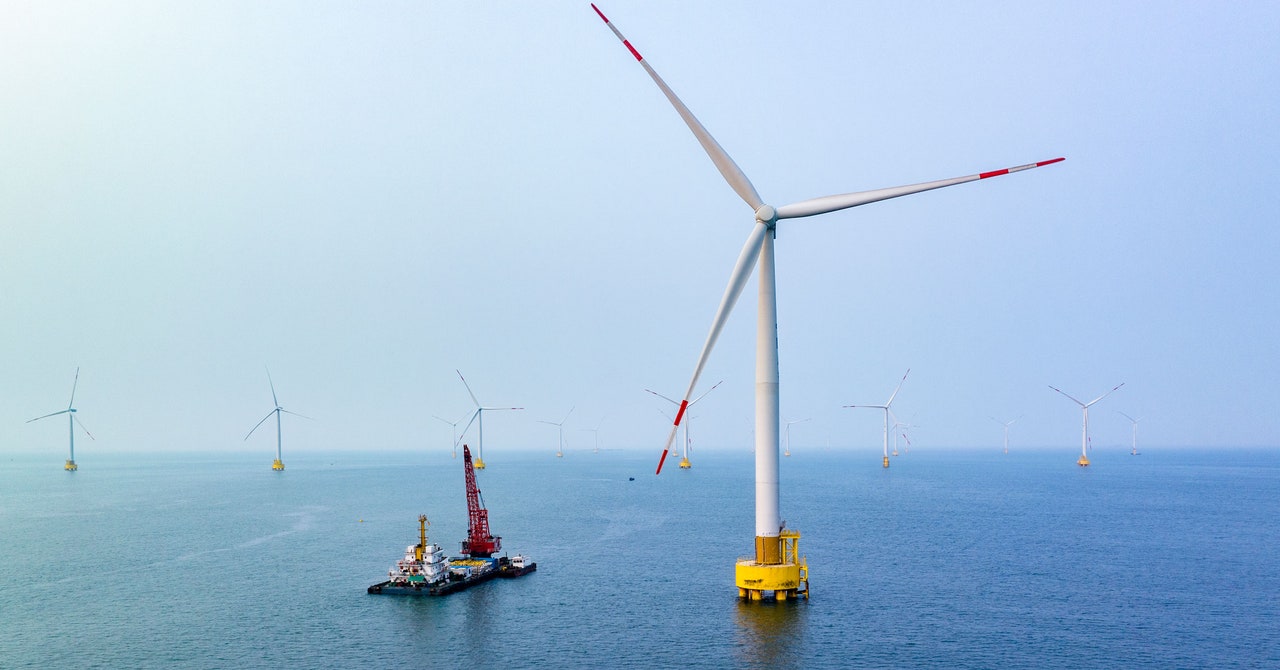
Despite the setbacks, the potential for offshore wind power generation in the United States is massive. The NREL estimates that fixed-bottom offshore wind farms in the country could theoretically generate some 1,500 gigawatts of power—more than the United States is capable of generating today.
There’s a lot the United States can do to make its expansion into offshore wind more efficient. And that’s where the focus needs to be right now, says Matthew Shields, an engineer at NREL specializing in the economics and technology of wind energy.
“Whether we build 15 or 20 or 25 gigawatts of offshore wind by 2030, that probably doesn’t move the needle that much from a climate perspective,” says Shields. But if building those first few turbines sets the country up to then build 100 or 200 gigawatts of offshore wind capacity by 2050, he says, then that makes a difference. “If we have ironed out all these issues and we feel good about our sustainable development moving forward, to me, I think that’s a real win.”
But today, some of the offshore wind industry’s issues stem, inescapably, from the Jones Act. Those inefficiencies mean lost dollars and, perhaps more importantly in the rush toward carbon neutrality, lost time.