
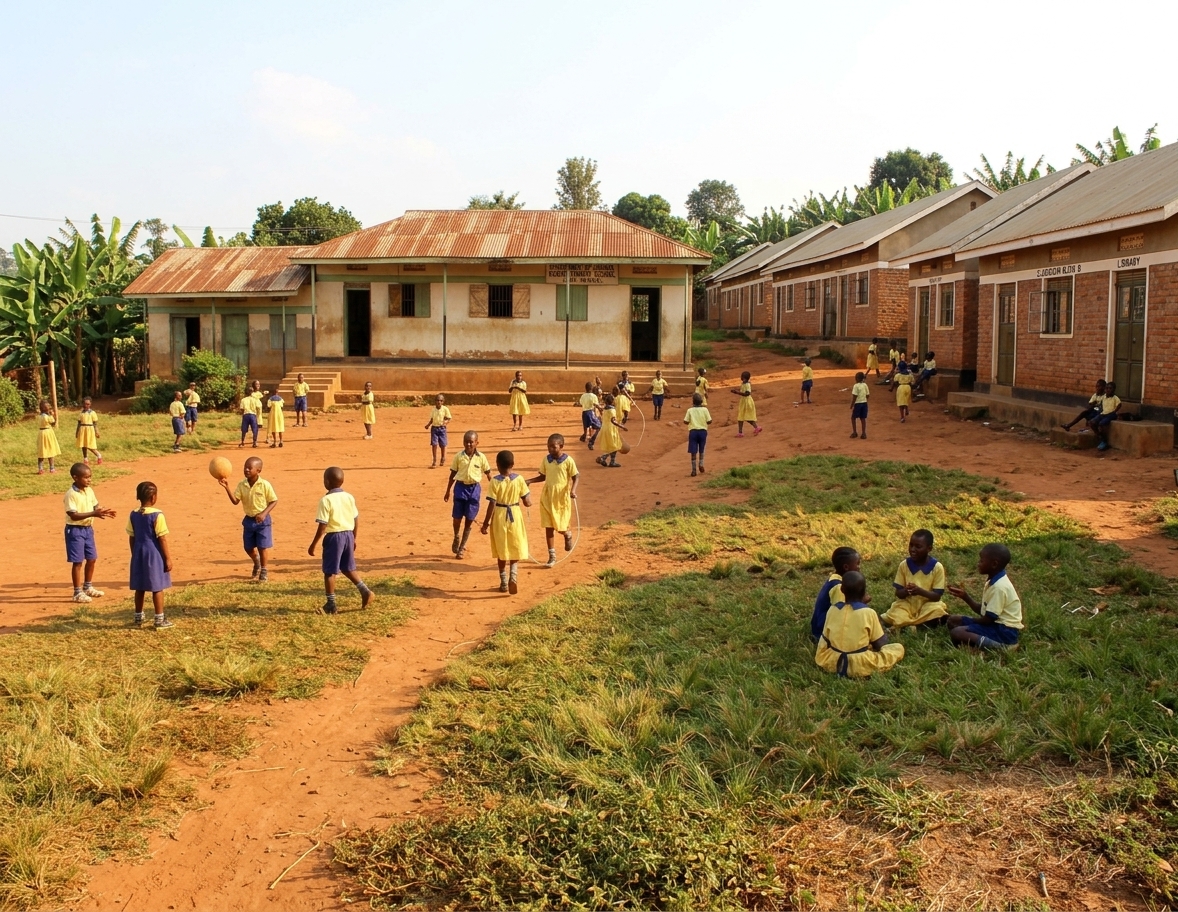
Ugandan pupils in lower primary will spend no more than three hours a day in structured learning under a new competency-based curriculum (CBC) set for rollout in 2028, the National Curriculum Development Centre (NCDC) has said.
Dr. Patrice Ssembirige, NCDC’s acting director, said the limits are designed to match young children’s developmental needs rather than treat them, as he put it, as “miniature secondary school students.” Under the proposal, children aged three to four would be engaged for a maximum of two hours a day, those aged four to five for two to three hours, and those aged five to six for about three hours, in sessions of 15 to 30 minutes at a time.
“There is no need for them to be in school as early as 5 a.m. We are looking at the physical development of the learners, cognitive, language, social and emotional aspects,” Ssembirige said, adding that the early-childhood curriculum has deliberately been kept light and remains under review as NCDC consults teachers and other stakeholders.
Before rollout, learning materials will undergo quality assurance and approval, with final sign-off from NCDC’s governing council in line with education ministry policy, Ssembirige said.
Building on secondary reforms
The lower-primary curriculum will align with the skills-based approach already in place at lower secondary, introduced in 2020. Speaking at the launch of the second International Conference on Curriculum Development, Gilbert Gift Siima, NCDC’s Secondary Department manager, said the model, which emphasises practical skills, critical thinking and creativity over rote memorisation, is now used in all schools implementing the lower-secondary programme, and has produced student-led projects, including a motorcycle built by learners in Entebbe.
However, Siima said implementation has been uneven, with many teachers, parents and other stakeholders still unclear on their roles. “The curriculum alone is just a plan,” he said, adding that learners themselves have responded well and are pushing for more interactive teaching.
NCDC is also drafting an A-level curriculum, currently being tested in select schools, that will similarly prioritise critical thinking and applied knowledge over theory. Siima asked for patience as testing continues, saying decisions on rollout would follow feedback from the pilot schools.
Officials said the reforms aim to prepare learners for a changing labour market, but cautioned that success depends on teachers, parents and communities understanding their roles, something lower-secondary’s rollout has yet to fully achieve.